
Back in For Starters #60 we talked through Value Stacks, a technique for articulating and quantifying value for a specific customer. Consider this part 2, where we turn that value estimation into a price.
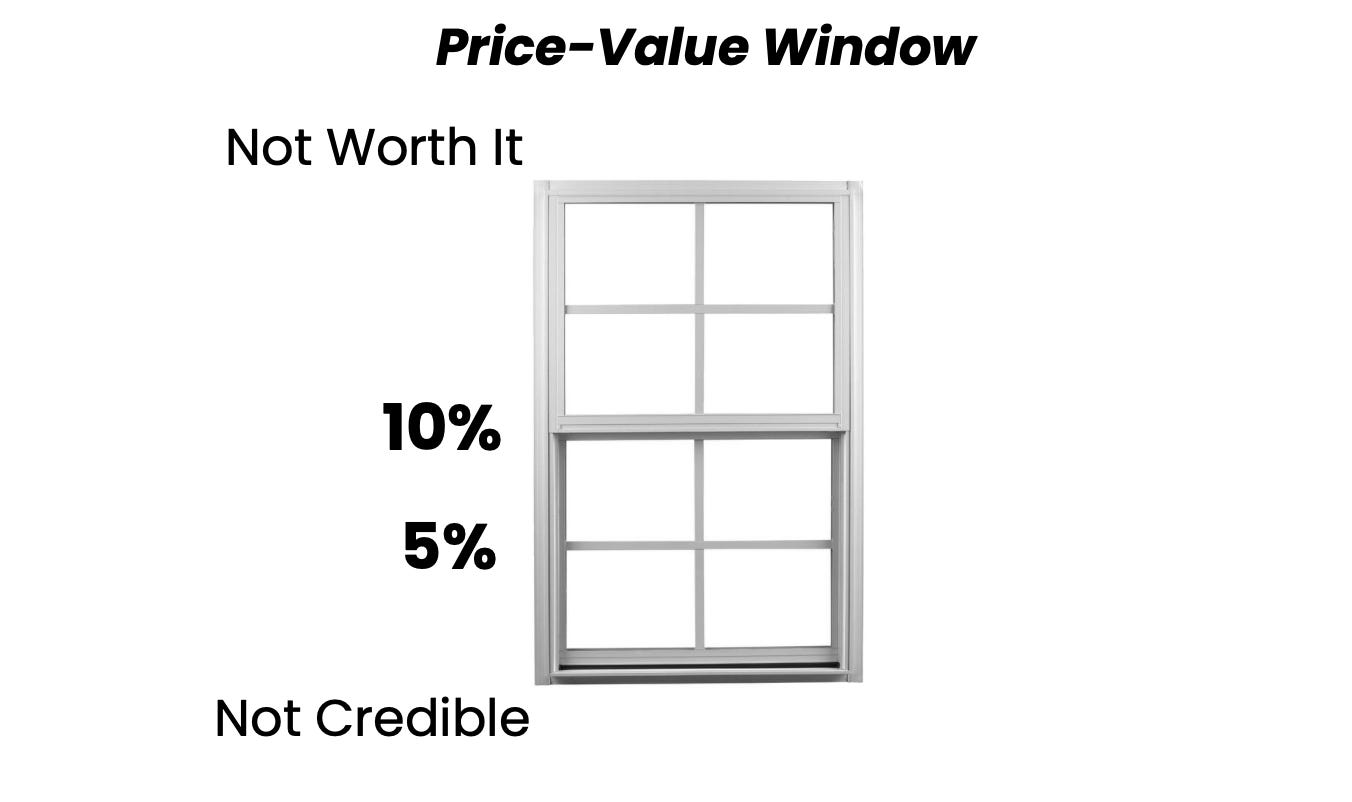
For starters, value, even quantified value, isn’t willingness to pay. Value is the customer’s expected outcome. Willingness to pay is a range of values the customer is comfortably paying to achieve that outcome. While hypothetically this is a very wide range, it’s most often <10% (definitely <30%). Price is a specific point that may or may not have any relationship to a customer’s expected value or their willingness to pay.
So, let’s quickly revisit the context of the Value Stack example, the Beneficiary is a CFO at a residential real estate brokerage with 10 agents and handling 100 transactions per year. We calculated $155,100 of annual value. If we calculated 5% of that value:
$155,100/20 = $7,755.
Now we have a price for this specific customer.
This is where too many people stop, setting one fixed price for all their customers. I can hear some of you asking, “but, aren’t all these customers buying the same thing, and as such shouldn’t they pay the same price for it?”
Yes, in this example, all the CFOs are buying greater confidence in their commission calculations, but what that means in their specific company is different. It changes based; on their number of agents, number of annual transactions, average transaction size, etc, etc, etc (all the variables in our value quantification algorithm). These differences in customer context account for the differences in value and differences in recommended price. Crafting value equations makes it easier to iteratively hone in the value within for each customer’s context.
For example if we held the price at $7,755 for all brokerages, some would be pushing the top-end of their willingness to pay and others would question the credibility of the solution.
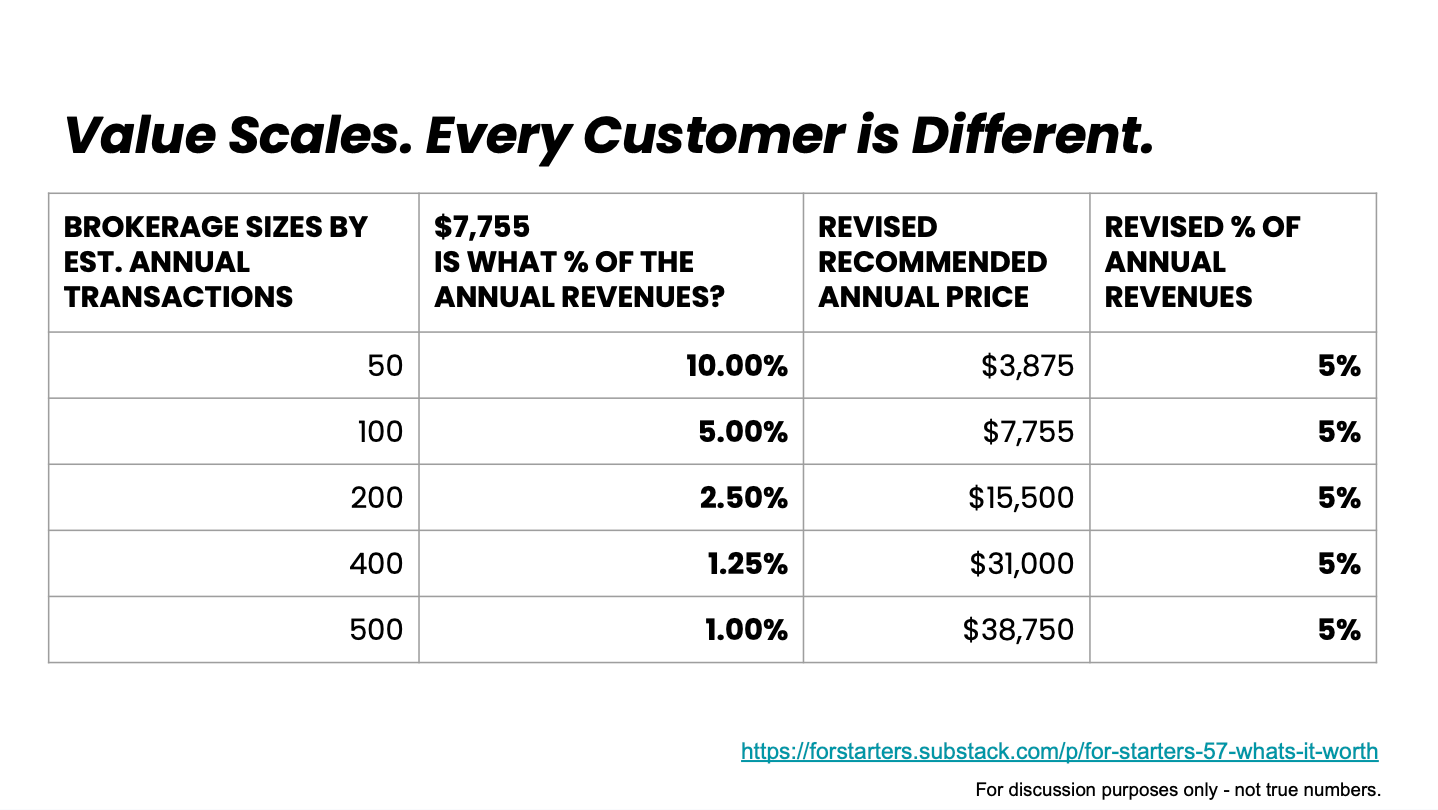
As we discussed in For Starters #52 – pricing is mostly packaging, acknowledging the customer’s specific context is a key part of packaging. This context is not just in the intensity of the problem but the business environment the problem exists in. Take SOC 2 Type II compliance for example. In most industries smaller customers won’t find this valuable at all, but for enterprise customers it’s table stakes. So, the audit becomes part of the packaging for enterprise customers.
Articulation of this kind of context-specific value is one way to credibly build a price above ‘Not Credible’ for larger customers.