
The Basics of Quantifying All the Value
Value Stacks are the bridge between the 1-sentence pitch (alternatively ‘jobs statement’)and an actual price.
Here’s a simple example I used in the presentation:
We help CFOs at
residential real estate brokerages
struggling to
accurately calculate commissions.
In this 1-sentence we have; a role, at a specific business, and a frustrating activity. That’s enough to introduce yourself at a cocktail party, but not quite enough to quantify customer value.
To quantify value we need separate all the different persistent frustrations the CFO is experiencing with accurately calculating commissions.
One way to get at all the discrete frustrations is to ask your customer, “What happens when a commission is calculated incorrectly?”
“Oh, I’ve had good Agents leave on the spot so now I spend so much time double and triple checking”
For this example, we’ll use these two;
- Maintaining a positive business relationship with Agents (Measured in Higher Retention, Lower Recruiting Costs)
- Time savings in making calculations
(Measured in Higher Confidence, Less Rework, Fewer Complaints)
This is the Value Stack at its core – explicitly listing out and quantifying all the discrete frustrations tangled up in a larger job. We don’t need to get super specific in our calculation, just need to capture all the meaningful things and get within the price-value window.
- Let’s start with “Maintaining a positive business relationship with Agents”, the brokerage won’t survive long without a good reputation with area Agents, so let’s estimate a few more details to get an idea of
- How many commissions is the CFO calculating on an annual basis? For napkin math purposes, let’s say the brokerage has 10 agents (on the small side) and each agent makes 10 transactions a year (very average), so 100 commissions.
- The average home sale price, for easy math lets say $500K
- The average brokerage commission, 0.009
- How much of the resulting dollar amount would the CFO attribute to positive business relationship with that individual Agent? Let’s say 30%.
That give us the following equation to quantify the annual value of Agent relationships:
500,000 * .009 * 100 = 450,000 * .3 = $150,000
- Now, for the second frustration, “Time savings in making calculations”. Let’s say the CFO has a $200K salary, works 240 days a year (480min/day) and because the current system is unreliable and inconsistent, he can save 30min per transaction with the new system.
$200,000 / (240 * 480) * 30 * 100 = $5,208
Much much less – an absolutely consistent with every time I’ve done this quantification against time, it’s rather disappointing. But makes for a fine example
So, the job of calculating commissions is worth $155,208 annually and $1,552.08 (Jeez Garrick, thought you said we didn’t need to get specific) per transaction to this CFO at this brokerage.
The Value Stack looks something like this:
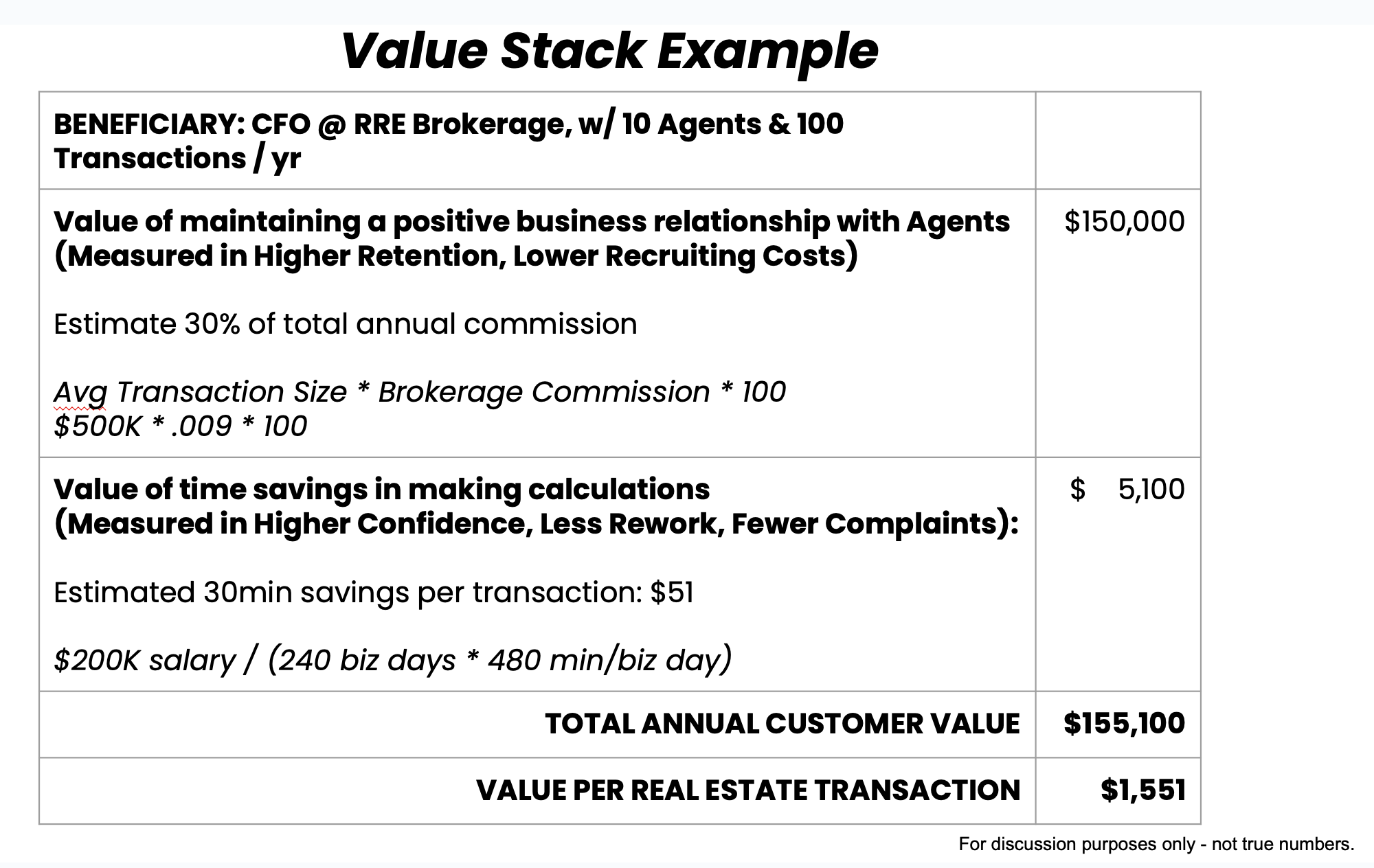
Notice BENEFICIARY in the top row?
The Beneficiary determines the value calculation. Someone has to receive the value, it may not be the buyer, maybe the Beneficiary is a new associate or a college intern home for the summer. In that case, at minimum the value of the time savings would be different.
Five Key Points about Value Stacks
- There’s always a Beneficiary of the value. Otherwise the value doesn’t exist. Who is the Beneficiary? What are all the things they value?
- Be comprehensive. Everyone interacting with the system should get some value out of it. Everyone attending the meeting is likely a Beneficiary expecting the system to help them in some way.
I’ve made multi-tab Value Stacks in spreadsheets for complex supply chain systems where each tab articulated the value for a different Beneficiary, and then all the numbers were rolled up into an overview to price the entire deal. - Everything can be quantified; reputational risk, time savings, brand value, peace of mind, all of it.
- The math is likely slightly different for every individual customer. (This is why I specified 10 Agents & 100 Transactions / Yr in the top row of the Value Stack) Don’t be overly concerned when the math doesn’t math exactly same. That’s what segmentation is. With enough customer volumes you’ll start to get clustering and many of the differences will come out in the wash.
- Show your work. Otherwise Future You won’t know how to get the same answer again.
In the next installment we’ll turn this value into a price point across different customers.
Until then, if you’d like some help with a specific value quantification, drop me a line.