
Thanks to all the readers requesting a discussion on pricing pages.
Across dozens of B2B SaaS and professional services pricing engagements, not one client has asked for help on their pricing page.
They ask for help with pricing architecture, customer segmentation, value articulation, tier structure, renewal strategy, or compensation plan impacts.
Not only do executives skip asking for pricing page help, none of these clients even maintain a public pricing page with a dollar sign and a “Get Started” button. For most B2B businesses, self-serve is not the business. It cannot be the business.
Over the past 13 years, Notion.com has raised $343M in funding at a $10B valuation. With the most recent round in 2021, the leadership team is under a great deal of pressure to fulfill the valuation.
That’s going to be tough at….pulls up pricing page….$10-$20/month.
Admittedly, they do have $600M in ARR. If we estimate an even split between ‘Plus’and ‘Business’ customers, it suggests 3.3million customers…approaching the entire population of Los Angeles, CA.
I know Notion is popular, but a paid customer base of that scale is highly improbable.
I’m not here to pick on Notion. Quite the opposite. In researching pricing pages for this installment, their pricing page is doing a disproportionate number of things strategically right.
But before we get there, a couple quick detours.
- Assuming annual compensation, all-in, for a full-time employee is $200K. That requires 833 customers paying at a $20/mn self-serve plan. 833 customers for everyemployee every year. We’re not even talking non-employee expenses…like servers or the ad spend to reach that many customers.
- So, what is a public pricing page for?
The pricing page is at best mirror of your best customers. It should tell them: “We understand the problem you’re trying to solve. We understand what’s valuable to you. We speak your language.” They’re not asking “Which tier do I want?”, they’re asking “Does this company understand my world well enough to actually test drive?” - OK, who are these $10/mn, $20/mn, $200/mn plans for then?
The self-serve tier isn’t the business. It’s the early alert system for where internal demand is forming at key enterprise accounts. These plans are for directors and senior staff who need to build an internal business case before procurement gets involved. The self-serve price point is designed to be expensed on their corporate card without approval, indefinitely.
This is how Github grew inside enterprise engineering organizations before a single enterprise contract was signed. It’s how Slack spread across corporate teams before IT knew it was there and Microsoft caught up.
That you and I, as civilians, can purchase and use these tools at all, is just another example of the mind-boggling high consumer surplus we currently live in.
Back to highlighting all the things Notion.com’s pricing page is doing well as a marketing page.
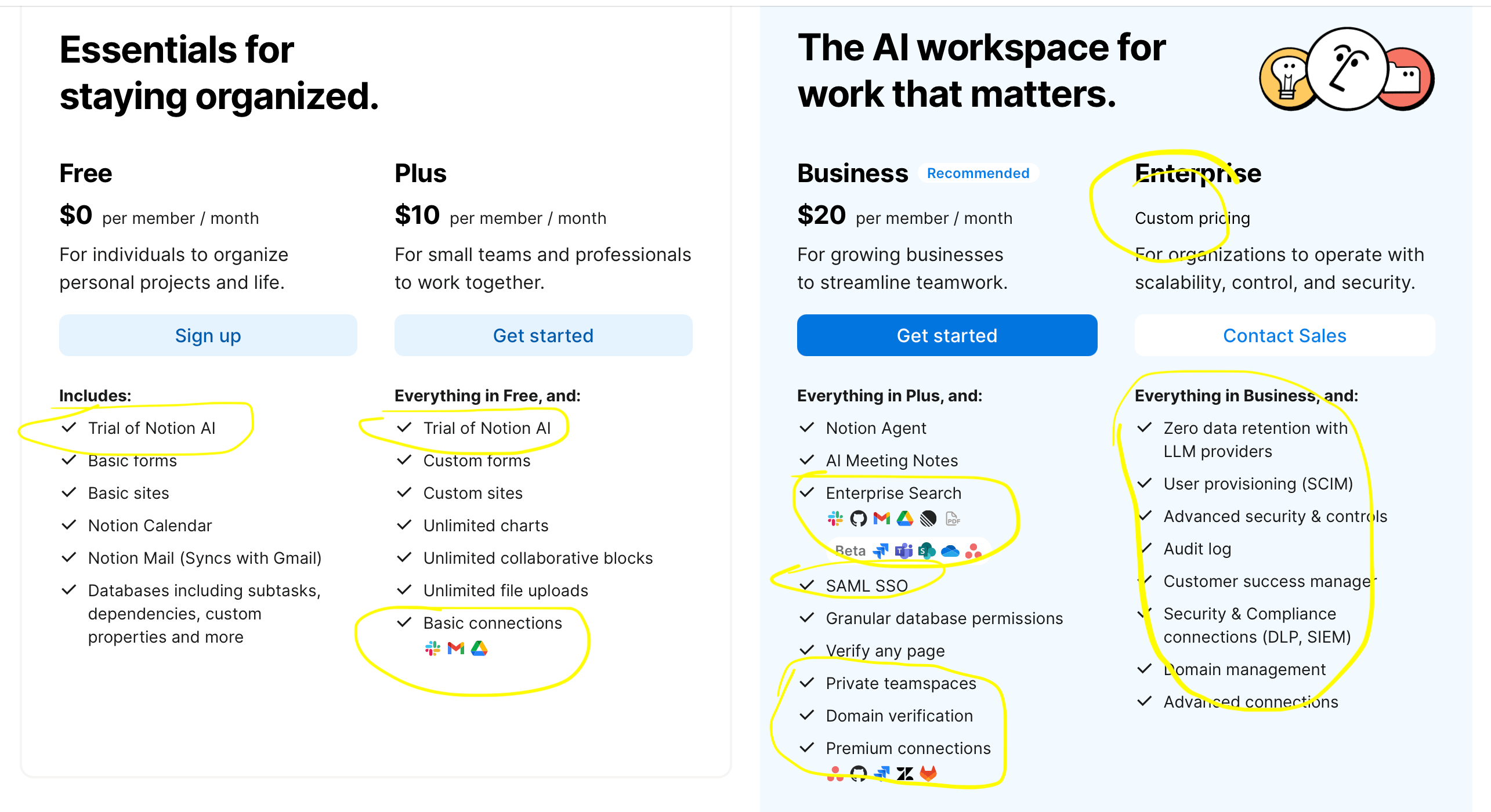
- No hard limits are specified anywhere. They’re not pricing incremental limits, they’re pricing sophistication of features, collaboration, and integrations.
- “Trial of Notion AI” on the Free and Plus tiers. The low-end tiers as marketing for features fully available at higher tiers. Fantastic marketing.
- “Basic Connections”. Yes, Notion can integrate us into a bunch of other tools, here’s a couple low value ones you probably already use to give you some idea of how it works. Upgrade for the ones you actually need.
- Also over on the Business and Enterprise plans, acronyms only meaningful to corporate IT security departments. We also see mentions of ‘domain’ features to help business customers further integrate into the internal and external facing tools.
- Also under Enterprise is: Customer Success manager. An actual person. I love it.
- Overall, lots of great stuff. Everything logically building toward Enterprise.
Two tests for whether your pricing page is doing its job.
- The language test. Is every word something a customer would use unprompted to describe their own problem. Not internal product names, not engineering-facing metrics, not your costs or constraints. Every mismatched word is a gap between you and your customers.
- The noun test. What noun are you pricing against? Seats, tokens, API calls these are all internal proxies. They measure access or cost, not value. Your best customers count something else: transactions, inspections, studies, campaigns, cases. If their noun doesn’t appear on your pricing page, how will they know you know them?
Notion’s nouns: forms, sites, charts, teamspaces, connections.
Intercom’s shift to pricing against “resolutions” is also a great example here.
Remember: Pricing pages are trailing indicators. They reflect past decisions about past customers in past market conditions. Clay.com took more than a year to design and roll out their action-based pricing model.
Copying their model today, it copying their past, not their forward-looking strategy. It’s highly likely there’s now an ongoing effort inside Clay closely monitoring whether they need to switch to something else entirely.
A competitor’s pricing page is their current best articulation of who their best customers is and what they value. Whether they’re right is a separate question. Whether they’re right for your best customers is another question entirely.